What to Buy With Your FSA Before It Expires: Useful Things You’ll Use
There is a very specific kind of panic that happens when you check your FSA balance toward the end of the year and realize you still have money sitting there.
Maybe it is $75.
Maybe it is $300.
Maybe it is enough that you suddenly find yourself scrolling through FSA-eligible products wondering if you need six first-aid kits and enough Band-Aids to supply a small elementary school.
Before you start buying random things just because they qualify, I think there is a better way to use that money:
This post contains affiliate links. As an Amazon Associate, I earn from qualifying purchases.
Start with the things you are going to need anyway.
Replacement contacts. Prescription glasses. Sunscreen. Medicine cabinet basics. Contact lens supplies. The things you buy regularly and the things you already know you will have to replace.
Then, if you still have money left, you can start looking at upgrades and a few higher-priced FSA-eligible purchases that you have actually wanted.
First, Check What Happens to Your FSA Money
Health FSAs are generally use-it-or-lose-it accounts, but your exact deadline depends on your employer’s plan.
Some plans allow a grace period. Others allow unused money to carry into the following year. For 2026, plans that offer a carryover can allow up to $680 to roll over, although your employer can set a lower amount. A health FSA generally cannot offer both a carryover and a grace period.
So before doing any end-of-year shopping, check your plan documents or benefits portal.
You may not actually need to spend every penny by December 31.
Also, this particular use-it-before-it-expires problem applies to FSAs, not HSAs. Money left in an HSA generally stays in the account and carries forward from year to year.
Now, assuming you really do have FSA money that needs to be used, here is how I would approach it.
Start With Things You Know You’ll Need Anyway
This is probably the least exciting category, which also makes it one of the smartest.
Look around your house and think about the medical, vision, skincare and health-related purchases you routinely make throughout the year.
Instead of asking, “What weird thing can I buy with my FSA?”
Ask:
“What am I probably going to spend my own money on six months from now?”
That one question changes the entire shopping list.
Order Your Replacement Contacts
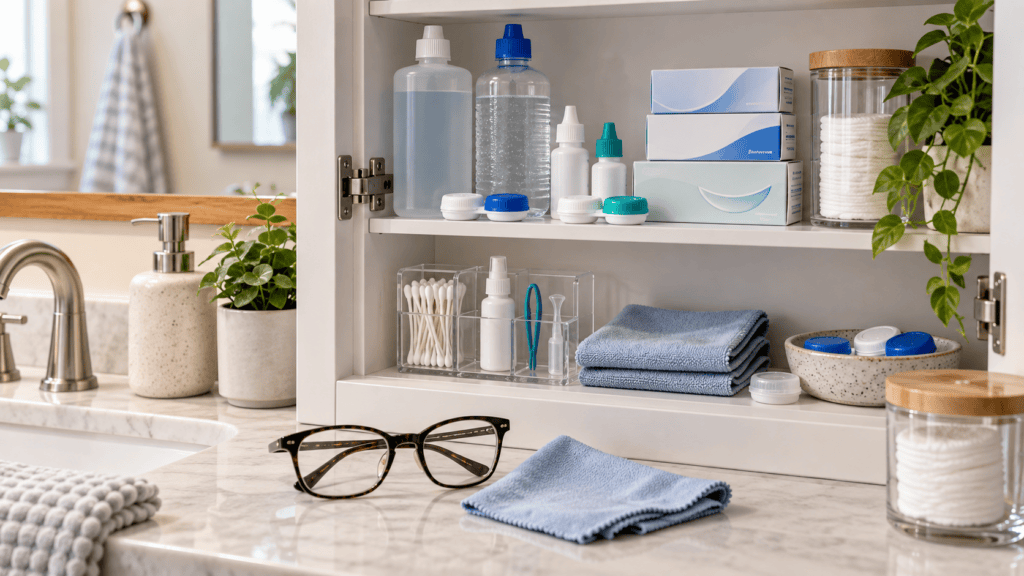
If you wear contacts, start here.
You already know another box of lenses is eventually going to be needed, so using remaining FSA funds to order replacement contacts can make much more sense than buying something simply because it happens to have an FSA-eligible label.
The IRS includes contact lenses needed for medical reasons as a medical expense. It also includes equipment and materials required for using contacts, such as saline solution and enzyme cleaner.
This is one of those expenses that doesn’t feel particularly exciting until Future You realizes she already has the next supply of contacts paid for.
Also check whether you are due for prescription glasses or prescription sunglasses.
If you wear specialty contacts or have a more involved lens-care routine, this is also a good time to look at the supplies you regularly go through rather than waiting until you are almost out.

Scleral lenses have a learning curve, but the daily routine becomes much easier with practice. Here is how I insert, remove and care for mine, along with the supplies that help make the process more manageable.
Restock Your Contact Lens and Eye-Care Supplies
This is another area where buying ahead makes sense because many of these products are things you repeatedly replace.
Think about your normal lens-care routine.
If you are going to buy the same cleaning or saline products again in a few months anyway, using remaining FSA money now can simply move that expense forward.
Just make sure the individual item is eligible under your plan before purchasing it.
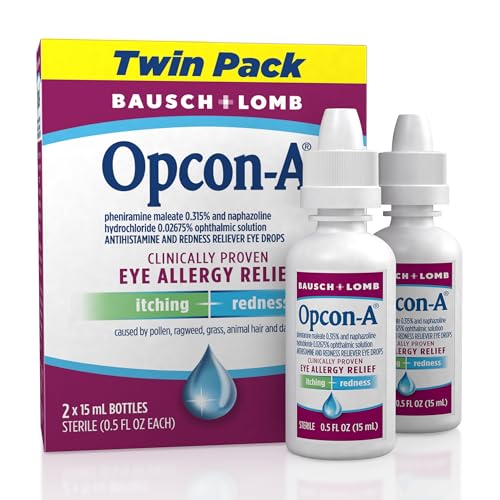
Restock the Medicine Cabinet
The medicine cabinet is another good place to check before buying anything new.
Instead of stocking up on things you have never used before, look at the products your household actually reaches for.
Over-the-counter medicines can generally be paid or reimbursed through a health FSA, even without a prescription. Menstrual care products are also treated as covered medical expenses for FSA purposes.
That can make this a good time to replace expired products or replenish things you routinely keep on hand.
Pain relievers, allergy medicine, cold medicine and other everyday OTC products can be much more useful than an impulse purchase you forget you own by February.

Replace First-Aid Supplies You’ve Actually Used
I am firmly in favor of having a first-aid kit.
I am less convinced that anyone needs seven first-aid kits simply because December is approaching.
Check the ones you already own first.
If you have used the bandages, gauze, wraps or other supplies, replenish them. You can also put together a small kit for the car, travel bag or another place where having one genuinely makes sense.
This is the general theme of this entire list: replace useful things before accumulating random things.

Stock Up on Sunscreen You Already Use
Sunscreen is one of my favorite practical FSA purchases because it is something many of us are going to buy again anyway.
Rather than trying an entire shelf of new products, this can be a good opportunity to replace the facial sunscreen, body sunscreen or other eligible sun-protection products you already know you like.
This is also where FSA skincare gets a little more interesting.
Some skincare products qualify while others do not, so I would not assume that an entire skincare routine is FSA eligible just because one product is.
I have a separate guide to FSA skincare products that work if you want to dig deeper into this category.

Don’t waste your FSA funds on random products. These skincare picks are actually worth it—from acne treatments to everyday SPF you’ll want to use.
Look at the Health Items You Keep Putting Off Replacing
This is where I would walk around the house before opening Amazon.
Is your heating pad on its last leg?
Have you been meaning to replace a worn brace or support?
Is there a health-monitoring item you regularly use that needs replacing?
Do you have something you have been borrowing from another room every time you need it?
These purchases are much easier to justify because they solve an existing problem.
The goal isn’t to find the most unusual thing your FSA will pay for.
The goal is to use the money on something that makes your everyday life a little easier.
Then Consider an Upgrade
Once you have covered the boring-but-useful purchases, this is where things get more fun.
Maybe you normally buy the cheapest version of something and have been wanting a better one.
Maybe there is a health device you have been considering.
Maybe you have been putting off replacing something because the nicer version costs more than you normally want to spend out of pocket.
Your remaining FSA balance can sometimes be a good opportunity to upgrade something you already use instead of adding another completely new product to your house.
This is also where I would start thinking about how much money is actually left.
If you have $40 remaining, you probably don’t need to turn this into a research project.
If you have several hundred dollars remaining, it is worth slowing down and looking at higher-priced purchases that would actually be useful.
If You Have a Larger Balance, Look at Eligible Beauty and Skincare Devices
This is the category that makes year-end FSA shopping considerably more interesting.
Certain acne treatments, skincare products and medical devices may qualify depending on the product and its intended medical use.
LED face masks are a perfect example.
Some LED light therapy devices may qualify for FSA or HSA spending, while others may not, so this is definitely a category where you want to verify the specific product rather than assuming every LED mask is eligible.
I wrote a full guide on whether you can buy an LED face mask with your FSA or HSA because there is enough confusion around this one that it really deserves its own explanation.
If beauty and skincare devices are what you are interested in, I also have a separate guide to FSA beauty devices that are actually worth considering.
This is where I would put the “splurge” money — after you have taken care of the things you already know you need.
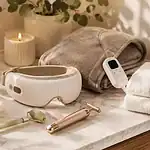
Not every FSA-eligible beauty device is worth the money. This guide shares beauty and wellness tools that can become part of your everyday routine—from LED face masks and facial massagers to relaxing heat therapy devices.
Shop Based on How Much You Have Left
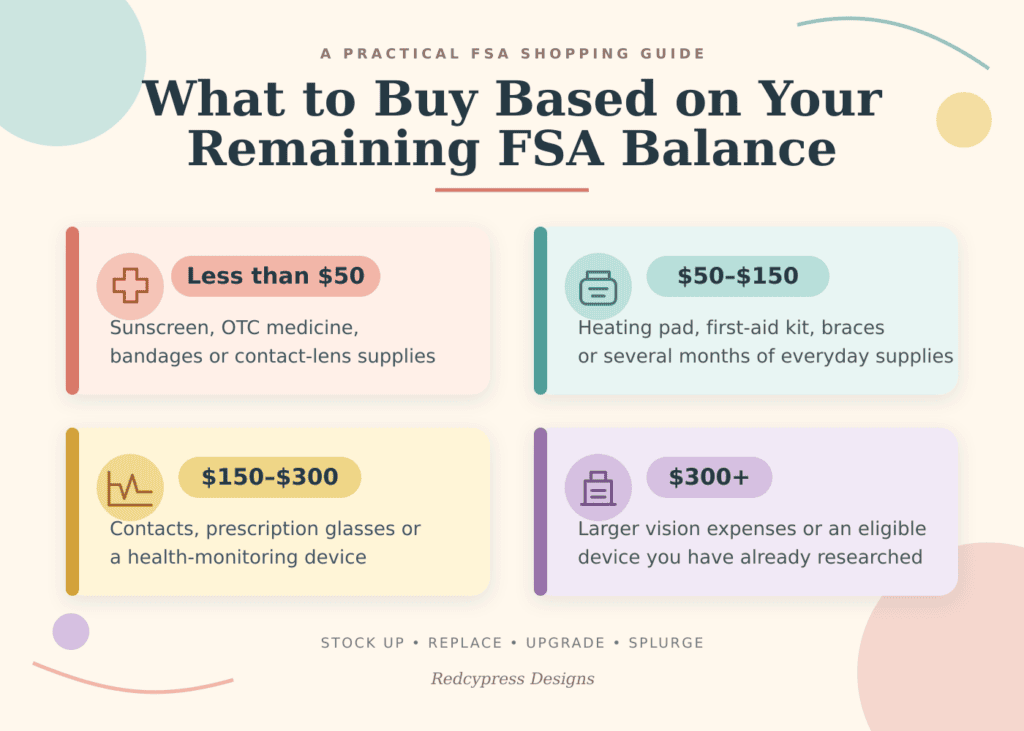
What to Buy Based on Your Remaining FSA Balance
Less than $50: sunscreen, OTC medicine, bandages or contact-lens supplies
$50–$150: heating pad, first-aid kit, braces or several months of everyday supplies
$150–$300: contacts, prescription glasses or a health-monitoring device
$300+: larger vision expenses or an eligible device you have already researched
Another way to make this easier is to stop looking at one enormous FSA product list and shop according to your remaining balance.
If you only have a small amount left, think about replenishing everyday supplies.
With a moderate balance, start thinking about replacement contacts, glasses, skincare, first-aid supplies or health products you have been meaning to replace.
If you have several hundred dollars remaining, look at the larger expenses already on your radar before filling your cart with dozens of small products just to make the balance disappear.
Sometimes the smartest use of $400 isn’t forty $10 purchases.
It is the $400 expense you were going to have three months from now anyway.
How to Check Whether Something Is FSA Eligible on Amazon
Amazon actually makes this easier than it first appears, but I still check individual products rather than assuming that everything within a category qualifies.
If you are not sure what to look for, I have a step-by-step guide on how to tell if something is FSA/HSA eligible on Amazon.
You can also add an eligible FSA or HSA card to your Amazon account, which I cover in my guide on how to add an HSA/FSA card on Amazon.
Eligibility can depend on the specific item and your plan, so when in doubt, verify the product and check with your plan administrator.
My FSA Shopping Order: Stock Up, Replace, Upgrade, Splurge
If I were trying to use an FSA balance before my deadline, I would shop in this order:
- Stock up on the eligible things I already buy regularly.
- Replace contacts, glasses, first-aid supplies and other things I know are wearing out or running low.
- Upgrade something useful that I have been meaning to replace with a better version.
- Splurge on a higher-priced eligible product I genuinely want and will use.
That keeps the goal from becoming “spend the money somehow.”
The goal becomes use the money well.
Don’t Buy Something Just Because It Says FSA Eligible
This is probably my biggest takeaway.
FSA shopping can get weird very quickly when you start browsing massive lists of eligible products.
Suddenly everything feels useful.
You do not need everything.
Start with your bathroom. Check your medicine cabinet. Look at your contact lens supplies. Think about appointments or vision expenses you already know are coming.
Then look at your FSA balance.
You might realize that spending the money is much easier than you thought — because most of the useful things were purchases you were going to make anyway.
And if there is still money left after all of that?
Then we can talk about the fun stuff.
Hello, LED mask.
More Redcypress Finds



More Practical Guides & Ideas

Lisa Thompson
 Hi, I'm Lisa, a software engineer, photographer, and creator behind Redcypress Designs. I share practical home solutions, beginner-friendly juicing tips, cozy living ideas, Pinterest experiments, and products that solve real everyday problems. Most of the projects, recipes, and reviews on this site come from my own experiences, testing, and occasional mistakes.
You May Also Like
Use Your FSA on These Skincare Products That Actually Work

The FSA vs HSA Availability Difference Most People Aren’t Told